A user calls the help desk. They cannot access a critical application. A ticket opens, escalates, and lands with the network team. Thirty to sixty minutes of investigation later, you find it: an interface that went down hours ago. The monitoring tool never fired an alert because it was averaging data in five-minute buckets.
That is what reactive network management costs. A 2022 report put the average cost of IT downtime at $12,900 per minute. Every minute of undetected fault time compounds that cost.
AKIPS was built specifically to close that gap, surfacing faults in seconds so engineers can act before any user notices.
Why Most Monitoring Keeps You Reactive
- Alert fatigue. Poorly tuned monitoring generates high volumes of low-quality alerts, training engineers to deprioritize them over time, including the ones that matter.
- Siloed data. When ping, SNMP, syslog, and NetFlow data live in separate tools, correlating a fault requires manual investigation across multiple dashboards, adding significant time to every incident.
- No historical context. Without granular, unaveraged historical data, engineers cannot determine when a problem actually started or what changed before the outage, which turns root cause analysis into guesswork.
How AKIPS Reduces MTTD and MTTR
AKIPS polls every MIB object every 60 seconds and pings every device every 15 seconds. Compare that to a five-minute polling cycle: the detection window shrinks by a factor of five immediately. On top of that, AKIPS processes SNMP traps and syslog messages in real time, capturing fault events between polling cycles that fixed-interval tools miss entirely. Most network faults surface in under 60 seconds.
Adaptive polling reduces SNMP traffic by approximately 60% by dynamically lowering the polling frequency on stable, unchanging MIB objects while maintaining full responsiveness the moment values change.
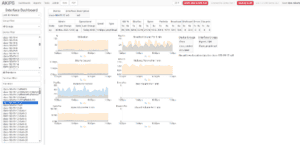
AKIPS also stores three years of unaveraged 1-minute historical data. When a fault is detected, engineers can go back to the exact minute a device started behaving abnormally, correlate it with a traffic spike or configuration change, and arrive at a root cause in minutes rather than hours. The built-in config crawler collects device configurations via 500 concurrent SSH connections simultaneously, so configuration diffs are available immediately rather than after a lengthy manual collection process.

In terms of escalation, alerts route directly to PagerDuty, OpsGenie, ServiceNow, Slack, Microsoft Teams, and Splunk. Because ping, SNMP, syslog, traps, NetFlow, and configuration management all live in one product, engineers do not need to cross-reference multiple tools to understand what happened.
What Teams Experience After Deploying AKIPS
In one engagement with AKIPS, CommonSpirit Health replaced a multi-tier CA Technologies monitoring system that left the team in constant reactive mode. After deploying AKIPS, both MTTD and MTTR decreased measurably, network capacity planning became data-driven using historical trends, and the platform became the single view for performance monitoring across the entire enterprise.
After deploying AKIPS, UNC Chapel Hill’s security team dramatically reduced the time required to isolate and resolve network outages, fulfilling its promise to decrease Mean Time to Repair (MTTR) and Mean Time to Detection (MTTD). AKIPS‘s ability to quickly sift through data and provide context and insights allowed the university to center its entire network management strategy around the tool, making the network more understandable and less dependent on the institutional knowledge of long-term staff.
Ready to see how MTTD and MTTR reduction maps to your current setup? Reach out to our advisors to request a demo.